- Free Economic Simulation Games
- Best Economic Simulation Games
- Online Economic Simulation Games
- Economic Simulation Games Mac Torrent
- Best Simulation Pc Games
Worldofmac Top free Simulation games for macOS Best MacGames-Download, Simulation Software for Mac – Free Software, NMac Ked – Mac OSX Apps & Games World Of Mac.net The 10 Best Simulation Games for Mac. Create a 21st century micro-nation and experiment with your political ideals. Citystate is a 2019 city building game, a Political-Simulator with a highly realistic economy. Democrats or Republicans Find yourself in one of the best presidential election games online. Decide which side to take, and then turn the presidential elections the way you want. Play online political games with your friends for free, leading your favorite party to the victory. Your candidate needs you!
| Part of a series on |
| Economics |
|---|
|
|
A simulation game is 'a game that contains a mixture of skill, chance, and strategy to simulate an aspect of reality, such as a stock exchange'. Similarly, Finnish author Virpi Ruohomäki states that 'a simulation game combines the features of a game (competition, cooperation, rules, participants, roles) with those of a simulation (incorporation of critical features of reality). A game is a simulation game if its rules refer to an empirical model of reality.'[1] A properly built simulation game used to teach or learn economics would closely follow the assumptions and rules of the theoretical models within this discipline.
In economics education[edit]
Economics education studies recommend the adoption of more active and collaborative learning methodologies (Greenlaw, 1999).[2] Simkins (1999) stated '… teaching practices, which rely heavily on the lecture format, are not doing enough to develop students' cognitive learning skills, attract good students to economics, and motivate them to continue coursework in the discipline.' (p. 278).[3] This is consistent with the results of a survey published in the American Economic Review by Allgood (2004) that shows that students 'rarely take economics as a free elective – especially beyond principles.' (p. 5).[4] More is needed to be done in the classroom to excite students about economics education.
I am looking for a game where you play the role of a detective/investigator in order to solve the game's mystery.I enjoyed playing 'LA Noire', however I did not like the fact that the game had. Good detective games for mac.
And now is the right time to make that happen, as the annual is underway.Until July 5, the leading digital games retailer is offering hundreds of Mac games at deep, deep discounts, including recent releases at 40 percent off or more, as well as some legendary favorites at just a few bucks apiece. Best mac compatible games on steam.
Simulations supplement the standard lecture. Both computerized and non-computer based simulation and games show significant levels of growth in education (see Lean, Moizer, Towler, and Abbey, 2006;[5] Dobbins, Boehlje, Erickson and Taylor, 1995;[6] Gentry, 1990;.[7]
Example in monopolistic competition[edit]
Through a simulation game, students may participate directly in a market by managing a simulated firm and making decisions on price and production to maximize profits. An excellent review of the use of a successful market simulation is given by Motahar (1994) in the Journal of Economics Education.[8]
A monopolistic competition simulation game can be used as an example in the standard economics classroom or for experimental economics. Economic experiments using monopolistic competition simulations can create real-world incentives that may be used in the teaching and learning of economics to help students better understand why markets and other exchange systems work the way they do. An explanation of experimental economics is given by Roth (1995).[9]
Assumptions of monopolistic competition
A simulation game in monopolistic competition needs to incorporate the standard theoretical assumptions of this market structure, including:
- Many buyers and sellers
- Easy entry and exit
- Some degree of product differentiation
- Zero economic profits in the long-run
In a simulation of monopolistic competition, each firm must be small in size, and should not be able to influence the direction of the overall market. Yet each firm has some control over price owing to product differentiation. To be consistent with economic theory, the simulation model should allow entry of new firms to occur as long as profits are greater than normal, and economic profits exist. The entry of new firms will decrease the market price, and eventually cause economic profits to return to zero (see Baye, 2009).[10]
Free dragon ball z games for mac. Vizzed Retro Game Room offers 1000s of free professionally made games, all playable online on the website.
Controllable decisions in monopolistic competition
To simulate monopolistic competition, the controllable firm decisions of the participants (students) must include, at a minimum, those specified in the standard theoretical model, including (see Baye, 2009):[10]
- Firm price
- Advertising
- Firm production
- Plant Size
Simulation game experience
From an educational point of view, students will have an 'opportunity' to learn by their own observations and experience through participation in a simulation game (see Schmidt, 2003).[11] Consistent with the theoretical model of monopolistic competition (see Baye, 2009),[10] student participants would observe and experience that their pricing decisions are controlled by the market. They would 'experience' that in the simulation they would have to lower their firm's price to be competitive as new firms entered the market. In the long-run, they would see the impact of changing plant size. They would observe that the successful firms would take advantage of economies of scale, but would also be careful not to incur diseconomies of scale in the long-run. Students would experience that economic profits cannot be maintained in the long-run. They would see, first hand, that their accounting profits will inevitably decline and move closer to normal profits. This experience provides students an opportunity to learn (as a supplement to the lecture and readings) the economic messages of monopolistic competition.
Example in Macroeconomics[edit]
In 2018, Harvard Business Publishing published 'Macroeconomics Simulation: Econland'. This 30-minute simulation brings economic policy making to life by allowing students to make monetary and fiscal policy decisions and consider their impact on the economy of a fictional country. Students manage the economy through a 7-year business cycle in an effort to maximize the approval rating from their population. Exploring the trade-offs of economic policy decision-making and the effects of the global economic environment on a country, students consolidate their understanding of core macroeconomic concepts, including GDP, unemployment, inflation, and budget deficit. At a deeper level, students develop critical thinking skills and learn about economic modeling and system dynamics. The simulation won a Silver Medal at the International Serious Play Awards.
See also[edit]
Notes[edit]
- ^Ruohomaki, V. (1995). Viewpoints on Learning and Education with Simulation Games in Simulation Games and Learning in Production Management edited by Jens O. Riis. Springer. pp. 14–28. ISBN O-412-72100-7.
- ^Greenlaw, S.A. (1999). 'Using groupware to enhance teaching and learning in undergraduate economics'. Journal of Economic Education. 30 (Winter) (1): 33–42. doi:10.2307/1183031. JSTOR1183031.
- ^Simkins, S.P. (1999). 'Promoting active-student learning using the World Wide Web in economics courses'. Journal of Economic Education. 30 (Summer) (3): 278–91. doi:10.2307/1183067. JSTOR1183067.
- ^Allgood, S.Bosshardt, W., Van der Klaauw, W., and Watts, M. (2004). 'What Students Remember and Say about College Economics Years Later'. American Economic Review. 94 (2): 259–65. doi:10.1257/0002828041301731.CS1 maint: multiple names: authors list (link)
- ^Lean, J., Moizer, M., Towler, C. A. (2006). 'Simulation and games'. Active Learning in Higher Education. 7 (3): 227–42. doi:10.1177/1469787406069056.CS1 maint: multiple names: authors list (link)
- ^Dobbins, C. L., Boehlje, M., Erickson, S., and Taylor, R. (1995). 'Using Games to Teach Farm and Agribusiness Management'. Review of Agricultural Economics. 17 (3): 247–55. doi:10.2307/1349570. JSTOR1349570.CS1 maint: multiple names: authors list (link)
- ^Gentry, J. (1990). Guide to Business Gaming and Experiential Learning. ABSEL and Nichols/GP Publishing. ISBN O-89397-369-6.
- ^Motahar, E. (1994). 'Teaching Modeling and Simulation in Economics: A Pleasant Surprise'. Journal of Economics Education. 25 (4): 335–342. doi:10.2307/1182981. JSTOR1182981.
- ^Roth, A.E. (1995). Introduction to experimental economics in The Handbook of Experimental Economics by Kagel, J.H. and Roth, A.E. Princeton University Press. pp. 3–109.
- ^ abcBaye, Michael (2009). Managerial Economics and Business Strategy. McGraw-Hill/Irwin. pp. 294–304. ISBN978-0-07-337568-7.
- ^Schmidt, Stephen J. (2003). 'Active and cooperative learning using Web-based simulations'. Journal of Economics Education. 34 (2): 151–167. doi:10.1080/00220480309595209.
References[edit]
- Allgood, S., Bosshardt, W., Van der Klaauw, W., and Watts, M. (2004). What Students Remember and Say about College Economics Years Later. American Economic Review, 94(2), 259-65.
- Dobbins, C. L., Boehlje, M., Erickson, S., and Taylor, R. (1995). Using Games to Teach Farm and Agribusiness Management, Review of Agricultural Economics, 17(3), 247-255.
- Fritzche, D., and Cotter, R. (1990). Guidelines for Administering Business Games, in Guide to Business Gaming and Experiential Learning, edited by Gentry, J., ABSEL, Nichols/GP Publishing, East Brunswick, 74-89.
- Gentry, J., ed., (1990), Guide to Business Gaming and Experiential Learning, ABSEL, Nichols/GP Publishing, East Brunswick.
- Greenlaw, S.A. (1999). Using groupware to enhance teaching and learning in undergraduate economics, Journal of Economic Education, 30(winter), 33-42.
- Lean, J., Moizer, M., Towler, C. A. (2006). Active Learning in Higher Education, Journal of Simulation and games, 7(3), 227-242.
- McHaney, R., White, D., Heilman, G. E. (2002). Simulation Project Success and Failure: Survey Findings, Simulation & Gaming, 33(1), 49-66.
- Mills, B.J. and Cottell, P.G. (1998), Cooperative learning for higher education faculty, Phoenix, Ariz.: Oryx Press
- Simkins, S.P. (1999), Promoting active-student learning using the World Wide Web in economics courses, Journal of Economic Education, 30(Summer), 278-91.
External links[edit]
- 'Association of Business Simulations and Experiential Learning (ABSEL) list of games'. Archived from the original on 19 March 2015.
| Part of a series on: |
| Simulation video games |
|---|
|
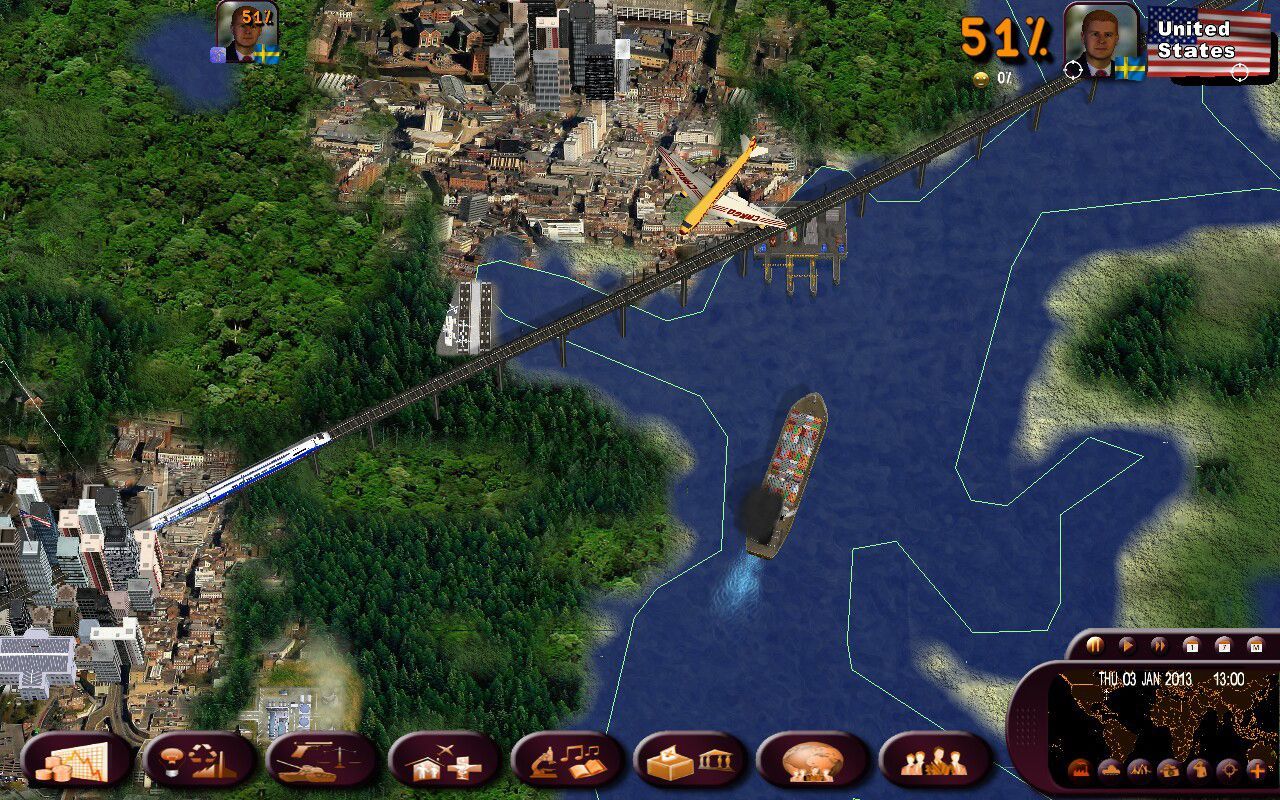
A government simulation or political simulation is a game that attempts to simulate the government and politics of all or part of a nation. These games may include geopolitical situations (involving the formation and execution of foreign policy), the creation of domestic political policies, or the simulation of political campaigns.[1] They differ from the genre of classical wargames due to their discouragement or abstraction of military or action elements.

Background[edit]
Free Economic Simulation Games
Games based on geopolitics and elections existed long before the emergence of personal computers and their ability to quickly process large amounts of statistical data. One of the earliest such games was The Game of Politics, created by Oswald Lord in 1935[2] which remained in print until 1960. In 1954, the board game Diplomacy was created, which differs from other wargames in that it features a 'negotiation' phase during which players reach agreements with other players, and then execute military moves simultaneously.[3] National politics has remained a vital area of board gaming, with products such as the 1986 board game Die Macher featuring elections in Germany,[4] and Wreck the Nation which satirizes the politics of the United States under the Bush administration.[5]

After enjoying years as a play-by-mail game, Diplomacy was one of the first games to move to take advantage of e-mail, and continued to be a popular email game into the 2000s.[6]
Computer gaming[edit]
Best Economic Simulation Games
As computers became more sophisticated, games in this genre moved beyond e-mail to more complex simulations. For most users in Europe, the first well known politics game was Dictator [ru], released in 1983 by DK'Tronics and running on Sinclair's ZX Spectrum. One of the earliest titles in this genre was Balance of Power, designed by Chris Crawford and published in 1985. This game features conflict at the height of the Cold War, using political and policy decisions to shape outcomes rather than warfare.[7][8] In Balance of Power, any armed conflict between the player and the opponent superpower results in a nuclear war, which is considered a loss condition.
Other Cold War era games included Conflict: Middle East Political Simulator created by Virgin Interactive, Spectrum Holobyte'sCrisis in the Kremlin and virtually unknown Hidden Agenda.
Conflict simulated a hypothetical situation in 1997 in which the player assumes the role of the Israeli Prime Minister and is obligated to employ various diplomatic and covert directives to defeat its rival nations. Surrounded by hostile nations, the player is restrained by a very limited military force and thereby encouraged to employ peaceful means to remain in power until he acquired more advanced weapons systems and power.[9]
In Crisis in the Kremlin, the user could play as the protege of any of the following Soviet politicians: Mikhail Gorbachev of the reformist faction; Yegor Ligachev, leader of the hard-line faction; and Boris Yeltsin, who was the prevalent figure of the nationalist faction. The player could use the simulation to test certain strategies to lead the failing Soviet Union into a new era of prosperity or force its dissolution and integration into the new world order. This game introduced the concept of budget management, citizen and faction satisfaction as well as multiple economic values and political spectrum.[10]
In Hidden Agenda the user takes the role of the president of Chimerica, a post-revolutionary Central American country, trying to juggle international relations and the needs of the country's citizens.
Early political simulation games were intended more for education than entertainment. In 1987, On the Campaign Trail was developed as a tool at Kent State University's political campaign management program, and engaged students in decision-making regarding the campaigns for United States Senate elections between 1970 and 1986.[11] Subsequently, a commercial market developed for packaged games involving elections and campaigns.
The 1992 game Power Politics (and, before it, 1981's President Elect)[12] focused on domestic United States political campaigns (but not the running of the country upon election). In 1996, this was adapted to the Doonesbury Election Game, designed by Randy Chase (who also did Power Politics) and published by Mindscape, in which players conducted a campaign with the assistance of a pool of advisors selected from characters in the Doonesbury comic strip.[13] A successor entitled Power Politics III was released in 2005.[14] In 2004, Stardock published Political Machine, in which the player steers a candidate through a 41-week election cycle for United States President, developing policies and tailoring talk show appearances and speech content. The game is heavily tied to modern polling methods, using real-time feedback for how campaign strategy impacts polling numbers.[15] In 2006, TheorySpark released President Forever 2008 + Primaries, an election simulation game that allows the player to realistically control an entire election campaign through both the Primaries and General Election. President Forever 2008 + Primaries itself a follow-up to the highly successful general election sim President Forever, released in 2004
Some games in the genre involve enacting policies and budget decisions to sway voters. One such game is Democracy, published in 2005 by Positech Games. In Democracy, players make decisions during each turn regarding which policies to support. As turns progress, the player views how their favourability rating changes amongst certain types of voters.[16] Candidates make promises before each election, and failure to follow through can result in lower support during the player's re-election campaign.[17] Other examples are the Geo-Political-Simulator series, produced by Eversim, boasting an array of choices for domestic policy and decisions based around current geopolitical issues,[18] and Tropico series.
There can also be found games that puts the player in the seat of a state leader, such as SuperPower, and its sequel, SuperPower 2, whose goals are to produce economic stability and prosperity, but the game mainly revolves around foreign policies, with the abilities to interact with other countries in many ways. The game includes a great number of real-life treaties that influence countries.
Online games[edit]
Web-based games such as NationStates allow players to manage the day-to-day decisions of individual governments, and compete against rival nations.[19][20] Less formally structured games are also played out in internet forums, where players manage governments and nations according to a set of agreed rules. These such forum-based simulation games - often known as 'Polsims' - simulate the politics of one specific nation throughout rounds set in differing time periods. Not all 'Polsims' take place on a national level. Some Polsims take place internationally, whereas others take place on the state or local levels. Players on such games play as fictional politicians and participate in debates, media activity, and simulated elections. Realism is highly stressed with key topics of the day often debated on and spun by the players and admins (who are able to shape the game world in any way that they choose).[citation needed]
In other web based games players register, apply for an open position (either a country or person inside a country such as a politician or army general) and carry out game activities either through newspapers or other activities or (more commonly) through gamemasters. Realism and cooperation tend to be highly promoted in such games.[citation needed]
Related games[edit]
Other construction and management simulations require government management. For example, city-building games such as the SimCity series of games developed and published by Maxis simulates the experience of being a mayor. SimCity features a real-time environment in which the player can create zones for city development, build roads, power and water utilities, and watch as their city develops based on their decisions. The game was originally published in 1989 and as of 2013 was in its fifth major release.[21]
Strategy games frequently make use of government management challenges. 4X games require the management of a government, be it tribal or interstellar. This includes tasks such as building infrastructure and conducting trade. Galactic Civilizations II requires players to manage their approval rating to keep their political party in power. Domestic policy is sometimes abstracted with more emphasis on international conflict. For example, the Civilization series gives players total control over resources, and radically restructuring an empire is a matter of clicking a 'revolution!' button.[citation needed]
How to Hide a Steam GameTo hide a Steam game, locate it in your library, right-click it, and then click “Set Categories.”Check the “Hide this game in my library” option and then click “OK.”How to Find or Unhide a Hidden Steam GameTo view your hidden Steam games, click the category box at the right side of the search box in your game library and then select “Hidden.”To unhide a hidden game, right-click it here and then select “Remove From Hidden.”How to Remove a Game From Your Steam AccountBefore removing a Steam game from your library, you should uninstall it from your computer. If you’ve played it recently, it will appear at the top of the list. You previously had to contact Steam customer support and ask for this, but there’s now a standard way you can delete games in a few clicks. Beware: To play the game again in the future, you’ll have to repurchase it. How do i fully uninstall a steam game on mac. If you remove a game from your account first, you won’t be able to uninstall it normally—you’ll have to hunt down its files on your hard drive or SSD and remove them manually.To permanently delete a game from your library, click Help Steam Support.Click the game you want to delete.
Other strategy games focus on government management to varying degrees. For instance, in the Hearts of Iron games (set in World War II) the civilian population is only a factor with partisans and manpower, whereas in Victoria a player must not only 'hobnob' and conquer, but implement the Second Industrial Revolution while warding off (or ushering in) real political revolutions such as the upheavals of 1848 and communist revolt.[citation needed]
Government and politics have also been incorporated into adventure games. A Mind Forever Voyaging, published by Infocom in 1985, was an interactive fiction game in which the player controlled a sentient computer capable of experimenting with potential future scenarios based on varying public policy decisions. Newsweek said of the game, 'It isn't '1984,' but in some ways it is even scarier.'[22]
The 2008 game Spore features a 'Civilization' stage where the player controls vehicles and interacts with other cities until they have control of all 12 cities.
Training and education[edit]
Beyond entertainment, these games have practical applications in training and education of government personnel. Training simulations have been created for subjects such as managing law enforcement policies (such as racial profiling), the simulation of a military officer's career, and hospital responses to emergency situations.[23]iCivics also features games such as Branches of Power, Executive Control, etc..
Online Economic Simulation Games
Examples[edit]
Economic Simulation Games Mac Torrent
- 270 | Two Seventy US Election (2018)[24]
- Balance of Power (1985)
- Bandit Kings of Ancient China (1989)
- Conflict: Middle East Political Simulator (1990)
- Crisis in the Kremlin (1991)
- Crusader Kings (2004)
- II (2012)
- III (to be released in 2020)
- CyberJudas (1996)
- Destiny of an Emperor (1989)
- Diplomacy (1954)
- Democracy (2005)
- 2 (2007)
- 3 (2013)
- eRepublik (2008)
- Floor 13 (1991)
- Geo-political simulator series
- Commander in Chief (2008)
- Rulers of Nations (2010)
- Masters of the World (2013)
- Hidden Agenda (1988)
- Jennifer Government: NationStates (2002)
- The Political Machine series
- The Political Machine (2004)
- 2008 (2008)
- 2012 (2012)
- 2016 (2016)
- 2020 (2020
- Particracy'
- The Political Process (2019)
- President Elect (1981)
- President Forever 2008 + Primaries (2006)
- Republic: The Revolution (2003)
- Republic of Rome (1990)
- Romance of the Three Kingdoms (1985-2016)
- Shadow President (1993)
- SuperPower (2002)
- SuperPower 2 (2004)
- Supreme Ruler series
- 1936 (2014)
- 2010 (2005)
- 2020 (2008)
- Cold War (2010)
- Ultimate (2014)
- The Great War (2017)
- Tropico series (2001–)
- Twilight Struggle (2005)
- Victoria 2 (2010)
References[edit]
- ^Tom Leupold (2004-08-12). 'Spot On: Games get political'. GameSpot. Archived from the original on March 13, 2007. Retrieved 2007-01-07.
- ^Time Magazine, February 3, 1936, 'Monopoly & Politics'
- ^Allan B. Calhamer, Europa Express #10, 'The Roots of Diplomacy'Archived 2012-07-31 at Archive.today
- ^Erik Arneson, 'Playing Politics'
- ^'BuzzFlash Reviews'. Buzzflash.com. Archived from the original on 2009-02-11. Retrieved 2011-01-17.
- ^Jim Burgess, 'Play-by-Mail Diplomacy vs Play-by-Email Diplomacy'
- ^Chris Crawford (2003), Chris Crawford on Game Design, ISBN0-13-146099-4
- ^Robert Mandel, The Journal of Conflict Resolution, Vol. 31, No. 2 (Jun., 1987), 'An Evaluation of the 'Balance of Power' Simulation', pp. 333-345,
- ^Zzap! Issue 70, February 1991, p.48, 'Conflict: the Middle East Political Simulator'
- ^Social Science Computer Review, Vol. 12, No. 3, 447-448 (1994), 'Software Reviews: Crisis in the Kremlin'
- ^Nadine S. Koch, 'Winning Is Not the Only Thing 'On the Campaign Trail': An Evaluation of a Micro-Computer Campaign Simulation' PS: Political Science and Politics, Vol. 24, No. 4 (Dec., 1991), pp. 694-698,
- ^'President Elect.' Moby Games (retrieved on January 25th, 2009).
- ^'IGN: The Doonesbury Election Game'. Pc.ign.com. 1995-12-30. Retrieved 2011-01-17.
- ^'Power Politics III (PC)'. GameSpy. Archived from the original on February 5, 2008. Retrieved 2007-12-22.
- ^Jason Silverman (2004-08-19). 'Campaign Game Mimics Real Life'. Wired. Archived from the original on September 18, 2008. Retrieved 2007-12-22.
- ^Jess Nickelsen. 'Democracy (PC)'. NZGamer.com. Archived from the original on 2014-08-05. Retrieved 2007-12-06.
- ^'Positech Democracy'. Retrieved 2007-12-06.
- ^Jackson, Stephen (2018-04-04). 'Best Political Games To Play On PC in 2018'. Gaming Respawn. Retrieved 2019-01-12.
- ^'NationStates - Walkthrough, Tips, Review'. Jay is games. Retrieved 2019-01-12.
- ^News, A. B. C. (2006-01-07). 'A Web Site of Virtual Nations'. ABC News. Retrieved 2019-01-12.
- ^Tal Blevins (2003-01-14). 'Sim City 4 Review'. IGN. Retrieved 2007-12-22.
- ^'Ad-Blurbs for A Mind Forever Voyaging'. MobyGames. Retrieved 2007-12-22.
- ^Dave Carey (2007-01-06). 'Simulation games help prepare government, unite local businesses'. The Washington Examiner. Archived from the original on 2012-07-20. Retrieved 2011-03-18.
- ^https://store.steampowered.com/app/855010/270__Two_Seventy_US_Election/
Comments are closed.